Thursday, 30 December 2010

bathroom vanity countertop

Granite supplier as a Granite counter top or vanity top has set the standard for durability, a sense of permanence, and outright aesthetic value. For busy modern living, a Granite counter top or granite vanity top delivers on a high-level of functionality. In process for millions of years, granite is one of the hardest natural stone materials in the world. Granite supplier is naturally resistant to the types of wear a Granite counter top or vanity top is likely to endure on a daily basis. Heat resistance, abrasion resistance to cutlery and other common kitchen items, as well as moisture resistance are all areas where granite excels. With Granite supplier, your kitchens and bathrooms gain this level of durability, along with a study sense of permanence too. Installing a Granite counter top or vanity top adds strength in both performance and as a notable design feature. Being a natural material, each Granite counter top features patterns and colors that make each Granite counter top or vanity top one of a kind. For a surface that offers a level of elegance that is often imitated but never equaled, a Granite counter top or vanity top is the surface by which all others are judged. Now through BuildDirect, Granite counter tops and vanity tops are also an affordable option. All of the strength and beauty offered by granite is now available within your budget for any residential or commercial Granite counter top or vanity top project


Facts About Granite Countertops

 Granite supplier is a cheaper alternative to marble and is notable for its strength and beauty . It is one of the toughest rocks in the world, making it a popular choice for Granite counter top. Educating yourself about the cost and advantages of  Granite supplier will help you decide whether it's the right choice for your home.

    Function

  1.   Granite supplier is most commonly used on kitchen counters where food is prepared. It is easy to clean, resistant to stains and looks good. A slab of  Granite supplier is cut, treated and polished until it's smooth and ready to be cut into a Granite counter top.
  2. Variations

  3. No two stones in nature look exactly the same, so Granite counter top have a unique design. No two Granite counter top will look the same, even if the same color is used. The types of  Granite supplier are mined from different locations around the world and, therefore, vary in price based on location and how common each piece is.  Granite supplier is available in a moderate selection of colors. Neutral colors are most common, but it also is available in a few colorful shades, such as red, green and blue.
  4. Advantages

  5.   Granite supplier has several advantages over other Granite counter top. Because granite is so strong and durable, it will last for years with little effort on your part. Cleaning  Granite supplier is as simple as wiping it down with a wet washcloth. The Granite counter top are sealed to prevent staining and this clear finish is what makes them so easy to clean.
    Granite counter top also add to the resale value of your home, according to a blog by Tammy Vertrees of Coldwell Banker Ponderosa Real Estate.
  6. Disadvantages

  7. Granite counter top are affected by acidic home cleaning products, which can eat away at the polished surface. Homeowners should use neutral cleaning products when washing counters, or stick to soap and water.

    The color choices are also more limited than other types of counters. Variety is available but is limited to the colors of the 
    Granite supplier found in nature.
  8. Cost

  9. Granite counter top must be installed by a professional, therefore, you will have to pay for labor costs in addition to the cost of the product. According to Reader's Digest, Granite counter top range from $75 to $105 dollars per square foot after the cost of installation has been added. This is higher in price than wood, tile or laminate Granite counter top and may discourage some homeowners from purchasing  Granite supplier.


Facts About Marble Tile

Marble is a metamorphic rock in the limestone family. When materials such as fossils, rock and sundry minerals recrystallize under extreme heat and pressure, marble is formed. During this process, veins are formed throughout the marble, making each piece distinct and difficult to duplicate. Marble can vary in size and color and can be cut to your specific needs.

      Removal
   1. Marble must be dug out from other rocks and is done so in large quantities.
      Size
   2. Marble is quarried in large sizes, which are cut down to varying sizes to marble small enough to be marble tiles in your home.
      Appearance
   3. Marble gets a worn, well-used look by tumbling the pieces inside a large drum containing sand.
      Defects
   4. Marble that has been processed may acquire cracks and small faults, which are sealed with pigmented resin to help keep the cracks from growing and ruining the marble tiles.
      History
   5. As early as 27 B.C., marble tiles were used by Romans when building structures to celebrate their gods.


Facts About Marble

Marble has been prized for its many uses for more than two millenia. The classical Greeks and Romans used it in their sculpture and architecture; Michelangelo immortalized it in his many Renaissance sculptures; and today it is still used for building and high-end designer finishes, as well as for art and sculpture. There are dozens of types and colors of marble, and it is quarried all over the world.

      Definition
   1. Marble is a metamorphic stone, which means that it is a rock that changes composition over time from one rock to another. In marble's case, limestone or dolomite are softened over time under conditions of intense heat and pressure, and then are recrystallized as marble.
      Composition
   2. Marble is composed of calcite, aragonite and dolomite crystals.
      White Marble
   3. White marble is highly prized for sculpture and architecture and is made from the purest of white limestones.
      Hardness
   4. Marble is a rating of between 2 and 5 on the Mohs scale of hardness for rocks and minerals, which means that it is a comparatively soft stone.
      Colors
   5. Marble is available in a rainbow of colors from pink, red, grey, green, brown and even black. Veined, streaked and other colored marbles are created from mineral impurities present when marble is formed, including sand, silt, clay and iron oxide.

minerals in marble

Many marbles contain other minerals that are usually silicates of lime or magnesia. Diopside is very frequent and may be white or pale green; white bladed tremolite and pale-green actinolite also occur; the feldspar encountered may be a potassium variety but is more commonly a plagioclase (sodium-rich to calcium-rich) such as albite, labradorite, or anorthite. Scapolite, various kinds of garnet, vesuvianite, spinel, forsterite, periclase, brucite, talc, zoisite, wollastonite, chlorite, tourmaline, epidote, chondrodite, biotite, titanite, and apatite are all possible accessory minerals. Pyrrhotite, sphalerite, and chalcopyrite also may be present in small amounts.

These minerals represent impurities in the original limestone, which reacted during metamorphism to form new compounds. The alumina represents an admixture of clay; the silicates derive their silica from quartz and from clay; the iron came from limonite, hematite, or pyrite in the original sedimentary rock. In some cases the original bedding of the calcareous sediments can be detected by mineral banding in the marble. The silicate minerals, if present in any considerable amount, may colour the marble; e.g., green in the case of green pyroxenes and amphiboles; brown in that of garnet and vesuvianite; and yellow in that of epidote, chondrodite, and titanite. Black and gray colours result from the presence of fine scales of graphite.

Bands of calc-silicate rock may alternate with bands of marble or form nodules and patches, sometimes producing interesting decorative effects, but these rocks are particularly difficult to finish because of the great difference in hardness between the silicates and carbonate minerals.

Later physical deformation and chemical decomposition of the metamorphic marbles often produces attractive coloured and variegated varieties. Decomposition yields hematite, brown limonite, pale-green talc, and, in particular, the green or yellow serpentine derived from forsterite and diopside, which is characteristic of the ophicalcites or verd antiques. Earth movements may shatter the rocks, producing fissures that are afterward filled with veins of calcite; in this way the beautiful brecciated, or veined, marbles are produced. Sometimes the broken fragments are rolled and rounded by the flow of marble under pressure.

The so-called onyx marbles consist of concentric zones of calcite or aragonite deposited from cold-water solutions in caves and crevices and around the exits of springs. They are, in the strict sense, neither marblemarble was the “alabaster” of the ancients, but alabaster is now defined as gypsum, a calcium sulfate rock. These marblesmarble”) of the Italian antiquaries, the reddish-mottled Siena marble from Tuscany, the large Mexican deposits at Tecali near Mexico City and at El Marmol, Calif., and the Algerian onyx marble used in the buildings of Carthage and Rome and rediscovered near Oued-Abdallah in 1849
nor onyx, for true onyx is a banded chalcedony composed largely of silicon dioxide. Onyx are usually brown or yellow because of the presence of iron oxide. Well-known examples include the giallo antico (“antique yellow


Wednesday, 29 December 2010

marble uses

Marbles are used principally for buildings and monuments, interior decoration, statuary, table tops, and novelties. Colour and appearance are their most important qualities. Resistance to abrasion, which is a function of cohesion between grains as well as the hardness of the component minerals, is important for floor and stair treads. The ability to transmit light is important for statuary marbles, which achieves its lustre from light penetrating from about 12.7 to 38 millimetres (0.5 to 1.5 inches) from where it is reflected at the surfaces of deeper lying crystals. Brecciated, coloured  marble, onyx marbles, and verd antique are used principally for interior decoration and for novelties. Statuary marble, the most valuable variety, must be pure white and of uniform grain size. For endurance in exterior use, marbles should be uniform and nonporous to prevent the entrance of water that might discolour the stone or cause disintegration by freezing. It also should be free from impurities such as pyrite that might lead to staining or weathering. Calcite marbles that are exposed to atmospheric moisture made acid by its contained carbon dioxide, sulfur dioxide, and other gases maintain a relatively smooth surface during weathering; but dolomite limestone may weather with an irregular, sandy surface from which the dolomite crystals stand out.

The main mineral in
marble is calcite, and this mineral’s variation in hardness, light transmission, and other properties in divers directions has many practical consequences in preparing some marbles. Calcite crystals are doubly refractive—they transmit light in two directions and more light in one direction; marble slabs prepared for uses in which translucency is significant are therefore cut parallel to that direction. Bending of marble slabs has been attributed to the directional thermal expansion of calcite crystals on heating

what is marble

Marble is a metamorphic rock made out of limestone. When limestone is subjected to tremendous pressure for a long time (like if limestone is buried under a lot of other rock or an ocean) it gets squashed into marble. marble is more beautiful than limestone and tougher, and so people like to use it for buildings.
marble senate floor
Multicolored marble on the floor of the
Roman Senate house
But marble is also rarer, and more expensive. A lot of marble is white, but marble can come in all different colors. In ancient Greece and Rome, people used marble (especially white marble to make statues, and they used colored marble in patterns to make hard floors that would last a long time. Different colors of marble
Sometimes people also used marble in thin sheets on the walls of fancy buildings like churches or palaces, to make a brick wall look fancier. When
marble was too expensive, people used plaster frescoes on their walls that were painted to look like marble. came from different parts of the Roman empire - the purple came from Egypt, for instance - and so this was also a way of showing off, of pointing out how powerful Rome was, that the Senate could bring stone from all these far away places that were ruled by Rome.


marble is in a beautiful house

Owning a beautiful house is an ultimate dream of most of the individuals. It is this dream that has led to an unprecedented craze for marble tiles  How? Well, before answering this, let's build it up a bit- what is the first thing a visitor at your house most likely to observe? Yes, you are bang on target with your pick- the floor of your room as immediately after stepping in, he/she will look down to see as to what lies beneath his feet. Now you would have understood as to why having a marble floor is slowly turning into a kind of status symbol and a matter of pride for a house-owner.

Marble supplier

Marble along with granite counter top has been the most common and popular types of marble tile. architecture has had a long tradition of using
marble tile and  granite counter top. Archeological evidences, in fact, suggest that marble floor tiles have been in vogue since early Vedic age. While marble is considered ideal for both floors and fireplaces, granite counter top is often used for countertops and fireplaces.

In the recent years, the craze for
marble tiles  has soared to the new heights thanks largely to the economy boom that has given birth to a large section of cash rich middle class who is ever ready to spend any amount of money on decoration and embellishment of their house.


granite floors tiles

Stone surfaces, be they marble wall tiles, granite counter top floors tiles or whatever, are not without their imitations. But this stone is a surface that imitations cannot come close to replicating. It's akin to having a wood grain effect on sticky-back plastic - it just fools no one and looks tacky as opposed to tasteful, meaning there's little point to the expercise.

It doesn't matter if you have marble floor tiles, or marble wall tiles, when it comes to this and other stones surfaces, there's not much you can do to them which will harm them in anyway, and the same can't be said for other floor and wall surfaces. Another benefit of
marble in particular is that there are no microscopic pores thanks to its denseness, and that means no hiding and breeding havens for allergy-inducing irritants that can be found easily on fabrics and woods.
Laying Floor Tiles |
marble Floor Tile not so Different from Ceramics!
It's not hard to work out by this short article that there's a real infatuation and enthusiasm about the use of stone surfaces in homes, and particularly marble. There's no doubt that it's a tasteful choice in home décor, and anyone bold enough to lay cream or black
marble floor tiles in any room, or even go all out for a marble mosaic floor, will be amazed at the transformation this makes on any living space. You might also be pleased to hear that laying marble floor tiles is not all that different from installing the ceramic tile. However, unlike woods and carpets, more thought does have to be given to the overall theme of a room when using any stone surface.

So it's a fact that arable floor tile designs are numerous and can be stunning in their appearance. It's also a fact that laying floor tiles, stone or ceramic, can be mastered pretty easily by all but the DIY Disasters that reside in some homes (you know who you are lol). And perhaps best of all, the
marble floor tile is super easy to clean and maintain. marble can be quickly washed with the single sweep of a floppy mop. It is for these reasons that marble tile flooring makes a perfect quality surface that requires very little maintenance. Beauty that never fails to give off a constant, natural sheen that's nothing short of beautiful in its simplicity. But hang on, we're not done yet!

A
marble foor surface is also treated easily with disinfectants that work best on hard surfaces. I would feel better having the sanitary marble floor tiles as opposed to wood floors in my kitchen and bath area. I also like the idea of using the marble tiles in my entry way because this area is often filled with dirt and germs as people come and go.

Perhaps after reading this you now ready to tear up those carpets and get to laying floor tiles
made of
marble! Ok, so that's a bit extreme, but more and more ambitious folks do get rid of their fabric floor coverings in place of the marble floor tile. In actual fact, it's even taking precedence over woods and modern ceramics in many parts of the country too. If you're looking for a little majestic splendour, then marble Floor Tiles are the way to go.


Marble Wall Tiles & Marble Floor Tiles for Homes

Conventional wallpapers and paints for walls in living rooms, along with carpets, rugs, woods or laminates are the most popular, but have you ever considered stone floors and walls? It might sound barren but done well certain stones can give you a look that's a cut above the current idea.
Are you ready for some new floor marble tile designs and ideas? Marble floors are no longer reserved for mansions and palaces, and a when carefully done, the bottom third of a room adorned with marble wall tiles can really give you a totally new style for your home. Stone is not cheap, but when you consider how it looks and how long it lasts, it is perhaps the best long term investment in home surfaces.
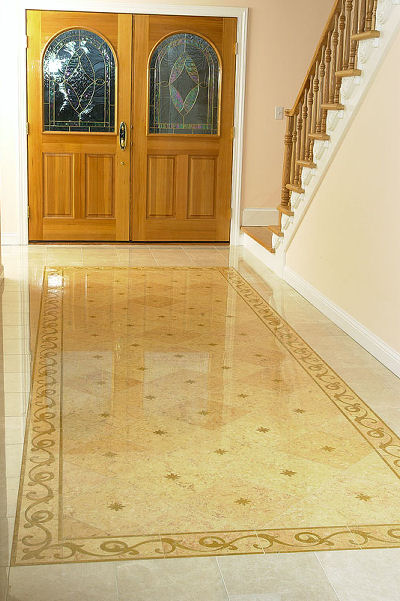
if experimenting with marble wall tiles seems a little bold at first, why not start with marble bathroom tiles and get a feel for this stately stone on a smaller scale. Of course, it's always a good idea to get some ideas online or from home & décor publications, as there are so many variations of marble as there are ways to present it. If time and money is on your side that perhaps a beautiful marble mosaic floor is right for your room, or even black marble floor tiles can look great when used in conjunction with white marble.

Most of us reading this will be familiar with laminate floor
marble tile , but marble wall tiles in the house, and especially marble bathroom tiles, are not the kind of thing you would come across in most contemporary homes, which is what makes marble so unique and special. Even though marble has been around since ancient civilization, it was once reserved only for homes of grandeur, and not the man in suburbia.

For most of us, we're not used to seeing
marble wall tiles inside the home, or any marble or stone tiles come to that, which makes it a bold move for anyone. In some cases, a marble mosaic floor, as beautiful as it is, would just look right of place in certain rooms. This would not be because of the size of the shape of the room, but more to do with the theme and overall décor of the space. Laying down marble flooring tiles, or wall tiles, may mean you have to accommodate the room to oblige the marble, and it is for this reason why so many are nervous to take the leap over to stones in homes.

Although home decorating ideas move with the themes and fashions of the day, surfaces in general are always slower to take on change. It took a good number or years and gradual exposure before wooden flooring started to become commonplace in homes. Now folks are happy to replace carpets with woods and laminates, but stone flooring is still looked at with uncertainty by most home owners. We're likely to see more
marble bathroom tiles than we are say exotic black marble Floor Tile Designs for the main rooms, but the momentum has begun and soon stone floors will be considered choices next to fabrics and woods.

So as you can see,
marble tiles are not restricted to use on floors but all manner of surfaces. If the room is decorated in the right way, you can take the tile from say a marble mosaic floor design and make table and worktop surfaces to match. It's hard to explain, but if you could see samples of taking marble wall tiles or from floors and then use that same stone for table tops and kitchen worktops, you will probably agree that this is a unique and very attractive use of marble .


History of marble and granite

Natural stones are rock formations formed by nature. These stones are formed naturally by enormous pressure under the earth. Natural stones were used in decorating and sculpturing right from the moment civilization was born. These natural stones are time tested for their natural beauty. Ancient buildings and monuments made of natural stones during early civilizations still stand erect narrating the beauty and durability of natural stones.
Modern people want to make their home stand out of the rest and they used natural stones for their floors and walls to bring about eternal beauty.
Granite counter top and marble are two main natural stones widely used in the stone industry. These stones are used in constructions as well as in monumental sculpture. Commercially, these stones are mined for use as architectural stones for flooring, cladding, curbing, counter tops and much more to be used at home.
Granite counter top is a widely occurring igneous rock. The texture of Granite counter top is generally medium to coarse grains. Porphyritic texture is very common in granite rocks. Various colors of Granite counter top stones are widely available and most of the times, Granite counter top is available as a massive rock. The beauty of Granite counter top is attributed to the deposits like quartz, feldspar, and mica. Consistent Granite counter top has same pattern throughout the stone. Variegated Granite counter top has various veins forming different patterns that are not easy to match.
It was the ancient Egyptians who quarried Granite counter top exclusively for use in various constructions. Most of their monuments were built using granite and limestone. The only remaining ancient wonder, The Great Pyramid of Cheops was built using limestone. The famous Pharaoh which is a symbol of outstanding Egyptian civilization was built with Granite counter top blocks. The Egyptians had marvelous sculpting skills and the Granite counter top blocks of Pharaoh were sewn in a perfect manner that you can't slide even a piece of paper between the rocks.
Pure white marble is a metamorphic rock of very pure limestone. marble is found extensively in various countries like Belgium, France, Great Britain, Greece, India, Spain and Italy. From classical times, pure white marble was considered as the best of its kind. In the beginning, only white marble was considered worthy and colored marble was considered impure. However, this belief was just short-lived because very soon, ancient civilizations appreciated colored marble too and used colored marbles in various monuments and sculptures even though pure white marble is always regarded high. Freshly quarried marble is easy to sculpture and the stone hardens as it ages.
Ancient Greeks were very much advanced in civilization and they were really fascinated about marble. Finest architecture and sculpting are specialties of Greek architecture and marble has been used in various Greek buildings. Exquisite statues with detailed carvings were made out of marble. Buildings built using Marble lasted for several ages. The Parthenon which was built in 441-437 BC is considered as a symbol of ancient Greek civilization and this scintillating building was built using Pentelicon marble.
The Greek empire extensively used marbles in their constructions. Temple of Artemis is one of the ancient wonders of the world and it consists of 127 marble columns each of which is 5 stories tall. It was the first grand structure made using marble. The magnificent construction was destroyed by various civilizations that took over Greece, but you can still find foundation and a few columns of the wondrous marbles.
When natural stones were widely used in constructing monuments and temples, it was the Greek empire that brought marble to personal use. References to baths and pools lined with marblecan be seen in ancient literature. Thassos marble was widely used in bathrooms and this type of marble is still quarried today for commercial uses. Building constructions using marble was popular in India too and the Taj Mahal, one of the Seven Wonders of the World was constructed using pure white marble stones.
After the Egyptian and Greek civilizations made some wonders with natural stones of granite and marble, the Roman Empire decided to try its hands on both Granite counter top and marble. Many of the roads of the Roman Empire were built using granite. Public baths became popular in Rome and these baths were made of granite. Pantheon in Rome used granite stones for columns and you can see these columns standing tall even today.
Romans loved Granite counter top and marble for different reasons. They used granite extensively for constructions because the stone is highly durable and strong. marble was mainly used for aesthetic reasons because Romans believed marble to be the most beautiful stone. Construction pattern of Egyptians and Greek was different from Romans. While the former civilizations used massive Granite counter top and marble stones to build constructions, Romans used bricks and mortar for buildings and then, lined them with marbleGranite counter top slabs. It is because of this reason that Romans were able to build marble cities in a short duration. and
The renaissance period is a golden period for all types of artwork. Artists and sculptors were interested in using natural stones for their artwork. Quarrying methods were improved by the time and technical use was invented. Innovative and novel users of natural stones increased during the renaissance period. Famous Michelangelo made several beautiful sculptures out of marble. Ornate decorations made using marble and Granite counter top were used in decorating churches, temples and other buildings of magnificent nature. Meanwhile, natural stones were carved into decorative pieces for use at home.
It was only during modern times that natural stones were brought close to mankind. Quarrying techniques were improved greatly and there was no need for men to die in quarries dealing with dynamites. Innovative technologies were used in mining natural stones. Also, the world started thinking about eco friendly materials to be used to construct homes. Architects and designers were overly enthusiastic about natural stones that were used in building monuments. In the last decade, people preferred to use more durable, yet stylish materials for constructing homes.
marble and Granite counter top are available in various patterns and colors and it was not easy to find the same pattern of stones. This uniqueness of natural stones made people want for more use of natural stones. In the ancient periods, marble and granite were used for lining and decoration. People trusted durable stones and lay flooring using Granite counter top and marble. Apart from their baths, living room, bed room and other rooms in the home had natural stone flooring.
Even though natural stones add exquisite beauty to the home, they are highly porous in nature. Harsh substances can easily damage these natural stones. However, thanks to latest technologies, that it is possible to add more strength to the stones and seal the porous nature so that these stones can be used extensively at homes. It was only during the last few years that countertops made of marble and Granite counter top became popular.
Natural and exquisite stones which were only used by kings and emperors are now available for a common man because floor tiles made of natural stones are much more affordable now. Consumers must be very cautious while buying floor tiles and Granite counter top made of marble and Granite counter top because natural stones are now made synthetically too. If you prefer aesthetic beauty for your stylish family, always ensure that you buy natural stones that were widely preferred by aristocrats of the past.